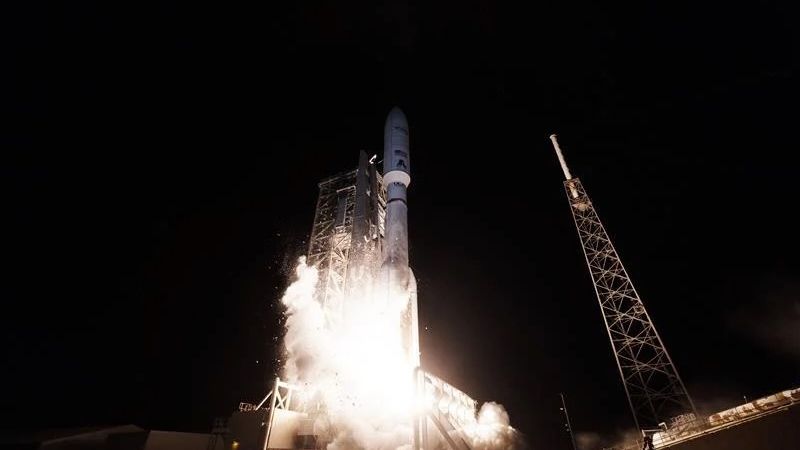
A United Launch Alliance Atlas V rocket launched 29 of Amazon's internet satellites on Monday night (April 27), tying its payload-weight record in the process.
ULA called Monday's mission Amazon Leo 6, because it was the sixth that the company has flown to help build out the Amazon Leo broadband constellation in LEO.
The network, a rival to SpaceX's Starlink internet megaconstellation, will eventually consist of more than 3,200 satellites, if all goes to plan.
It will take more than 80 launches by a variety of rockets to finish assembling Amazon Leo, which used to be known as Project Kuiper. Just 10 of these liftoffs have occurred to date. The Atlas V has now flown six of them, SpaceX's Falcon 9 has launched three and Arianespace's Ariane 6 rocket has launched one.
The Ariane 6's tally will increase soon, however; it's scheduled to launch an Amazon Leo mission from French Guiana early on Wednesday morning (April 29).
The first four Atlas V Amazon Leo missions sent 27 of the broadband satellites skyward. Amazon Leo 5, which launched on April 4, boosted that number to 29 and set a new record for the heaviest payload ever flown by an Atlas V in the process — 18 tons.
Amazon Leo 6 tied that mark, as it also launched 29 Amazon Leo satellites to the final frontier.
Editor's note: This story was updated at 10:30 p.m. ET on April 27 with news of successful launch and satellite deployment.