Tom's Hardware Verdict
If you want a gaming headset that supports multiple devices and has a base station, the A20 X has a very small base station.
Pros
- +
Very lightweight
- +
Attractive lighting
- +
Small, thin base station
- +
Supports multiple devices
Cons
- -
Feels cheap
- -
Bluetooth does not work without base station
Why you can trust Tom's Hardware Our expert reviewers spend hours testing and comparing products and services so you can choose the best for you. Find out more about how we test.
Logitech-owned gaming headset brand Astro is all about gaming. So much so that its headsets are not really designed for any type of non-gaming listening, which is why they connect with multiple gaming devices and are surprisingly... unportable. But since we're looking for the best gaming headsets, this is right up our alley.
The Astro A20 X is a lightweight wireless gaming headset designed to connect to two devices (it's compatible with Xbox, PlayStation, Nintendo Switch, and, of course, PCs), with a detachable boom microphone, and bright, attractive RGB lighting. It looks a lot like the Logitech G522 we recently reviewed, because the design is practically identical — the main difference is that the A20 X comes with a multi-device base station while the G522 does not. The A20 X is also about $40 pricier than the G522, at $179.99.
Design and Comfort of the A20 X
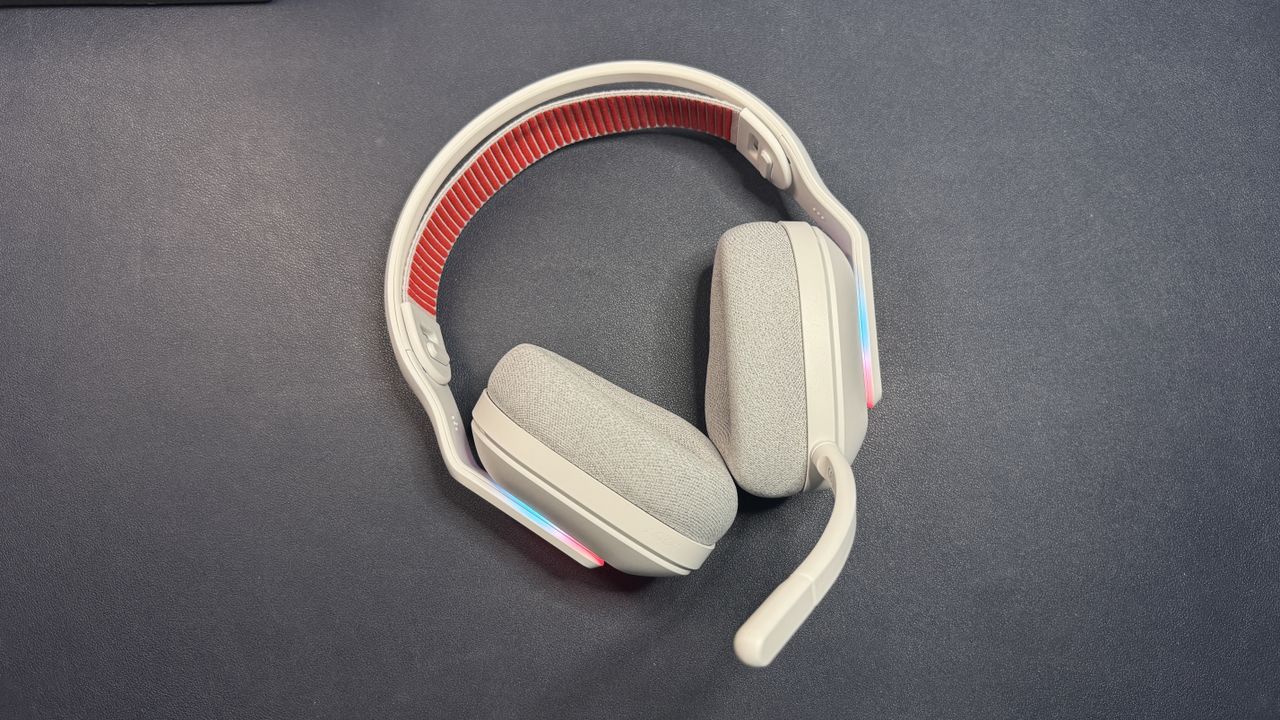
The A20 X is a wireless over-ear (circumaural) headset with a lightweight plastic build, an elastic strap for adjustment, and bright, customizable RGB lighting on the earcups. It features a detachable boom microphone and it comes with a small wireless base station that lets you connect the headset to two devices at once — PC, PlayStation, Xbox, or Nintendo Switch. The A20 X comes in black and white colorways; our review unit came in white. The white headset features light gray cloth-covered earpads and red accents — the underside of the headband, the quick-switch button, and the mic-mute button are all red. The black version has the same red accents, but the earpads are black to match the frame.
The A20 X doesn't look too different from other lightweight, all-plastic wireless headsets, such as the Corsair Void Wireless v2. But it especially doesn't look different from other lightweight, all-plastic headsets from Logitech — in fact, it's virtually identical to the Logitech G522 headset. It's the exact same headset, build-wise: It has the same angular plastic earcups, the same split plastic headband, the same stretchy, elastic adjustment strap — it even has the same mirrored silver Logitech G logo on the yokes. The main difference between the A20 X and the Logitech G522 is the A20 X's base station, which allows you to connect to two devices, e.g. a PC and a console, and quickly switch between them.
Adjustment-wise, the A20 X is pretty minimal — perhaps too minimal. The earcups tilt and pivot slightly to better fit your head, but do not swivel to lie flat (or anywhere close to that). They are not height adjustable at all — instead, height adjustment is via the elastic ski-band-like strap that connects to two plastic protrusions on the inside of the headband. The strap has two notches on each side, which gives you a total of three different lengths (four, I suppose, if you count removing the strap altogether). This isn't a lot, and the headband is pretty stretchy — I found that even the shortest setting was a little too big for me. Luckily, the headset was light enough that it didn't cause much discomfort, but I did occasionally feel like the headset was slipping down/off.
Speaking of weight, the headset is super lightweight — it weighs around 10.23 ounces (290g), which makes it one of the lightest headsets we've tested. It's even lighter than the airy, open-back wireless Turtle Beach Atlas Air, which weighs 10.32 ounces (292.5g) without the microphone (10.61oz / 301g with the mic). It's a very comfortable headset, with a low clamping force and soft, fabric-covered memory foam earpads, but it feels like it might fall off if you turn your head too quickly.
The earcups feature bright, attractive lighting on each side, which can be customized using Logitech's G Hub. Each earcup has four RGB zones, all of which can be changed individually. The lighting is on the face of each earcup and is slightly recessed, so it's not something that people will see if you're facing them (e.g. if you're facing the camera while streaming) — they'll only see it if you turn your head.
There are several controls and ports on each earcup. On the left earcup, starting from the back, there's a power switch, a Bluetooth button, a volume wheel, and a microphone mute button, as well as a USB-C port and a 3.5mm microphone jack for plugging in the headset's detachable boom microphone. On the right earcup, starting from the back, there's a quick-switch button for switching between the two devices you have connected to the base station, as well as a chat mix rocker that lets you adjust the volume between game and chat audio.
The A20 X comes with a few accessories in the box: two 6-foot (1.8m) rubber USB-C to USB-A cables (presumably for connecting devices to the base station), the very slim base station, and the detachable boom microphone.
Specs
Driver Type | 40mm bio-cellulose (dynamic) |
Impedance | 36Ω |
Frequency Response | 20 - 20,000 Hz |
Design Style | Over-ear (circumaural) |
Microphone Type | omni-directional |
Connectivity | 2.4GHz wireless, Bluetooth 5.3, wired (USB |
Weight | 10.23oz. / 290g |
Cord Length | N/A |
Battery Life | 90+ hours with lighting turned off |
Lighting | Yes (8 zones) |
Software | Logitech G Hub |
MSRP / Price at Time of Review | $179.99 |
Release Date | Oct. 2025 |
Audio Performance of the A20 X
The A20 X features Astro's 40mm bio-cellulose dynamic drivers, which have a frequency response range of 20 - 20,000 Hz. This is the standard frequency response range on many gaming headsets, though we've been seeing more and more headsets push beyond this range (on both sides).
The A20 X sounds, unsurprisingly, a lot like the Logitech G522. It has a semi-neutral sound profile, with the mids standing out and a slightly pumped up low end, and relatively restrained highs that are turned up just enough to make footsteps and gunshots stand out slightly. It's not the most exciting or dramatic sound profile, but it's... fine, out of the box. All forms of media — games, music, movies, podcasts, etc. — will sound adequate on the A20 X out of the box, but you'll need to play with the EQ if you want to get the most out of this headset.
Logitech G Hub comes with a handful of "curated presets" to get you started, including "bass boost," gaming, FPS gaming, and "media." You can also create your own presets, and you can get a pretty solid bass response with some tweaking. The headset also features plenty of detail, though it has a somewhat narrow soundstage, making rich audio environments like cities and jungles in games sound particularly alive (though perhaps a bit oppressive).
You will need to use Logitech G Hub to tweak and switch between EQ presets, however, as there doesn't seem to be a way to quickly switch between them on the headset itself. However, like the Astro A50 X, the A20 X doesn't really work without its base station (it does, but... not really), so I guess that shouldn't be too much of an issue.
Microphone of the A20 X
The A20 X has a detachable boom microphone with an omni-directional polar pattern and a frequency response range of 70 - 20,000 Hz. The mic plugs into a 3.5mm jack (trapezoid-shaped, to direct the orientation) on the left earcup, and sits on the end of a semi-flexible 4.5-inch gooseneck arm. It can be manually muted using a button on the left earcup, and it features a bright red light at the tip when it is muted, so you know whether people can hear you.
The microphone is pretty solid for a headset mic, though it's not the absolute best we've used and it doesn't compare to a standalone USB gaming mic. But it does a very good job of capturing your voice and making it sound full and well-rounded, even without any of the Blue Vo!ce presets turned on. It does a pretty good job of keeping background sound to a minimum, even though it's omni-directional (not cardioid or hypercardioid) — though, of course, typing on a loud keyboard will still be somewhat obvious.
But like all Logitech mics, the A20 X is supported by Logitech's G Hub software, which means you also have access to the Blue Vo!ce microphone technology. This includes a mic EQ as well as several signal cleanup options, such as noise reduction, a de-esser and a de-popper, a noise gate, and a compressor. The EQ comes with several curated presets, including AM/FM radio presets, two broadcast options, and a night/whisper preset that works surprisingly well.
Features and Software of the A20 X
The A20 X is configurable through Logitech's universal peripheral software, Logitech G Hub. You can use G Hub to update firmware, tune the headset and microphone EQ, and customize the headset's RGB lighting, as well as adjust several settings such as sidetone, game/chat mix, audio prompts, and power management. (It also gives you access to a sound board, if that's something that interests you.)
The A20 X has three forms of connectivity — 2.4GHz wireless, Bluetooth 5.3, and wired via USB-C. Both the 2.4GHz wireless and the Bluetooth connections work through the base station, which means that the headset does not work wirelessly without the base station. You must be within range of the base station for both the 2.4GHz wireless connection and the Bluetooth connection to work. It does, however, work without the base station if you plug it in via USB-C, so it's at least somewhat portable — and the base station is extremely slim and lightweight, so you could take it with you pretty easily if you wanted to travel with it. But you'd still need to have it plugged into your PC for it to work, so it's not what I would call travel-friendly.
Also, the wireless connections do not support simultaneous playback — you'll need to press the Bluetooth button on the left earcup to switch between 2.4GHz wireless and Bluetooth. The switch is quick and seamless, but this feels like it makes the Bluetooth connection even less useful. Still, I understand the point of this headset is to be able to seamlessly connect to multiple devices and switch between them simultaneously, and I have seen how connections can get mixed up in headsets that attempt to do it while also making the headset fully portable. The SteelSeries Arctis Nova Pro ambitiously attempts to connect to multiple devices and have simultaneous dual-wireless Bluetooth connectivity that's not dependent on the base station, and I have had several issues
Logitech rates the battery life of the A20 X at up to 90 hours with the lighting turned off, and up to 40 hours with the lighting turned on. This is actually better than I expected, considering how bright and flashy the lighting is.
Bottom Line
The Astro A20 X is a pretty solid gaming headset if you're looking for a multi-device headset and you don't need something you can take out of the house. The base station is convenient and small, and switching between devices is quick and seamless — though it doesn't have simultaneous dual-wireless connectivity like the Astro A50 X. But if you don't want to switch between your PC and your console, the Logitech G522 is the same headset without a base station, and it costs just $129.99 versus the A20 X's $179.99.