
The most common planets in the galaxy don't appear around the most common stars, TESS observations suggest

Sadie Harley
scientific editor

Robert Egan
associate editor
This article has been reviewed according to Science X's editorial process and policies. Editors have highlighted the following attributes while ensuring the content's credibility:
fact-checked
peer-reviewed publication
trusted source
proofread
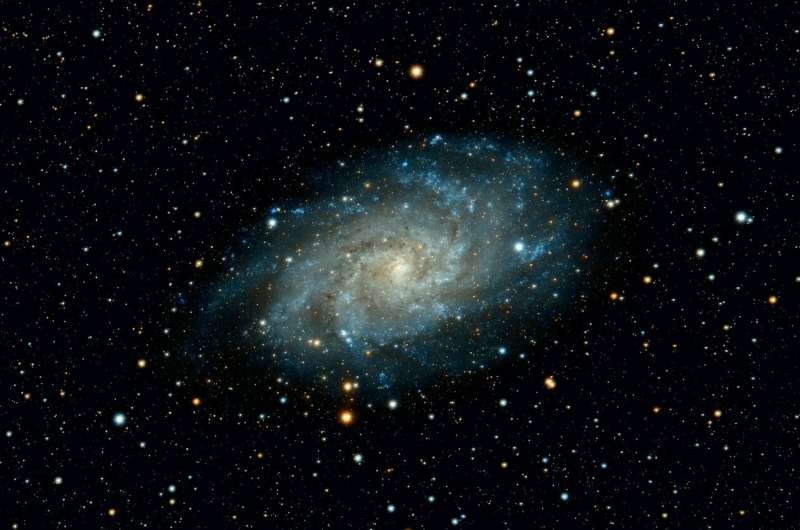
Astronomers now estimate there is at least one planet for every star in our galaxy. These worlds, called exoplanets, are planets that orbit stars outside our solar system. But new research from McMaster University reveals a surprising twist: the most common planets in our galaxy don't exist around the most common stars.
Around stars like our sun, the most common planets are sub-Neptunes—worlds thought to resemble Neptune but smaller in size—and super-Earths, rocky planets that are up to 10 times more massive than Earth. For nearly a decade, astronomers have known that these two types of planets are widespread around sunlike stars across the galaxy. But sunlike stars make up only a minority of the stars in our galaxy, leaving a gap in our understanding of how planets form.
Turning to small, dim M dwarfs
To fill that gap, McMaster researchers examined planets orbiting mid-to-late M dwarfs. These are small stars, just 8% to 40% the size of our sun, that make up most of the stars in the Milky Way. Because of their faintness, these stars have historically been difficult to study.
NASA's Transiting Exoplanet Survey Satellite (TESS) has changed that. By observing a new patch of sky every 28 days, the satellite surveys the entire sky over 26 months, providing an unparalleled view of these stars and the planets that orbit them.
Sub-Neptunes vanish around M dwarfs
Using the TESS data, the McMaster team discovered that around mid-to-late M dwarfs, sub-Neptunes almost completely disappear. These stars host many super-Earths but virtually no sub-Neptunes, challenging existing theories of planet formation.
"We didn't just refine the picture—we changed it. Around these stars, sub-Neptunes effectively vanish, which means the mechanisms shaping planets here are different," says Erik Gillis, a Ph.D. student in the Department of Physics and Astronomy. Gillis conducted the work under the supervision of Ryan Cloutier, assistant professor and Canada Research Chair in Exoplanetary Astronomy.
Rethinking photoevaporation and formation
Astronomers have long attributed the distinction between super-Earths and sub-Neptunes to photoevaporation, a process where intense starlight strips away a planet's atmosphere. Mid-to-late M dwarfs are extremely active and should be capable of evaporating planetary atmospheres efficiently, but not to the extent we're seeing here, explains Gillis.
The fact that sub-Neptunes exist in such small numbers around these stars suggests that planet formation here may favor water-rich worlds rather than gas-shrouded sub-Neptunes.
"If we want to understand the origins of planets and the origins of life, we need a complete picture of how planets form and what they're made of. This research brings us closer to that," says Gillis.
A rapidly evolving exoplanet field
The findings, published in The Astronomical Journal, come at a time when exoplanet science is growing rapidly. The first exoplanets were discovered just 30 years ago—a blink of an eye compared to some other astronomical fields.
Since then, we've only been able to study a small slice of the universe to build a picture of planetary systems. We assume these patterns hold everywhere because the same physical processes shape planets across the galaxy.
"Our solar system was once the only example we had. Now, thanks to missions like TESS, we can compare thousands of systems and uncover patterns that rewrite our assumptions," says Cloutier.
"It was already astonishing to learn that the most common planets in our galaxy do not exist within our own solar system. Now with this recent work we're developing a clearer picture of where these super-Earths and sub-Neptunes come from."
Publication details
TESS Planet Occurrence Rates Reveal the Disappearance of the Radius Valley Around Mid-to-late M Dwarfs, The Astronomical Journal (2026). DOI: 10.3847/1538-3881/ae5810
Journal information: Astronomical Journal
Provided by McMaster University